

13 July 2023
Stepping Up to the ESG Challenge
The evolving role of auditors

Petaling Jaya, 13 July 2023 - The traditional role of internal auditors is expanding to encompass Environmental, Social and Governance (ESG) practices and disclosures, particularly as companies integrate ESG into their operations.
“The increasing scrutiny on how ESG requirements are managed and the integrity of disclosures provides an opportunity for internal auditors to carve their position in their respective organisations,” said Suhailah Mohamed Abdulla, Sime Darby Plantation Berhad’s (SDP) Chief Integrity and Assurance Officer. “It is therefore important for internal auditors to equip themselves with the necessary skills and knowledge in this space to add credibility to the internal audit function and create a bigger impact.”
Suhailah was speaking at a Breakfast Talk organised by SDP and the Malaysian Institute of Corporate Governance (MICG) yesterday on: “Stepping up to the role: Objective Assurance & Advisory on ESG”. Devanesan Evanson, Chief Executive Officer of Minority Shareholders Watch Group moderated the discussion. Other panellists were MICG’s Governor, Marina Yong Poh Nyuk, and Permodalan Nasional Berhad’s Senior Vice President & Head of Investment Stewardship, Muazzam Mohamad.
Panellists discussed the role of objective and independent assurance to establish trust and credibility in companies’ Environmental, Social & Governance (ESG) practices and disclosures. They also highlighted emerging trends and common challenges faced in ESG assurance and advisory, and the best practices to address them.
MICG Governor Marina Yong said that with greater scrutiny from regulators and investors, it is critical that boards are provided the full picture of the company’s ESG performance and ambitions to be confident that their ESG reporting is fair and sufficiently ambitious.
“Independent and thorough internal and external audits play a significant role in providing this assurance to the boards. However, internal auditors face huge challenges in upskilling to undertake ESG audits as the subject is not only vast, but also complex. Companies must therefore be strategic in accelerating the building of ESG audit competencies internally, not just for reporting purposes, but to transition to ESG compliance as rapidly as possible. While the additional cost of developing the ESG knowledge and capabilities is the primary concern of most companies, being left behind while others leap ahead in ESG strengths would ultimately be more costly,” she said.
Suhailah added that companies are increasingly recognising the importance of integrating ESG considerations into their operations, not just as a moral imperative, but also as a strategic advantage. In this context, the role of audit professionals in providing objective assurance and advisory on ESG matters has gained significant importance.
“Their expertise and guidance can help to ensure that real positive impact on ESG is delivered, enabling companies to meet stakeholder expectations on ESG which is important in enhancing companies’ long-term viability and resilience,” she said.
The Breakfast Talk was attended by MICG Chairman and the Board of Governors, as well as Chairman, Board Members, Senior Management and Executives from several GLC and MNCs including Sime Darby Plantation, Petronas, FGV Holdings, Telekom Malaysia, TNB, MTDC, Dutch Lady, KPJ Healthcare, IOI Global Service, SP Setia and UEM Sunrise.

23 August 2023
Sime Darby Plantation Registers RM830 million in Profit Before Interest and Tax in 1H FY2023
- Realised crude palm oil prices averaged RM3,765 per metric ton in 2Q FY2023
- Interim dividend of 3.25 sen per share declared
Petaling Jaya, 23 August 2023 - For the six months ended 30 June 2023 (1H FY2023), Sime Darby Plantation Berhad (SDP) registered a Profit Before Interest and Tax (PBIT) of RM830 million, a decline from the RM2,206 million recorded in the corresponding period. SDP registered a Net Profit for 1H FY2023 of RM449 million as compared to RM1,530 million recorded in 1H FY2022.
The decline in the Group’s year-on-year (YoY) profits was primarily due to lower average realised crude palm oil (CPO) and palm kernel (PK) prices, which have declined from the peak levels witnessed in the previous year. This was further exacerbated by higher operating expenditure, mainly from higher fertiliser prices and labour costs, particularly in Malaysia where the Group is rehabilitating its operations. In 2Q FY2023, realised CPO prices declined 28% YoY to an average of RM3,765 per metric ton (MT), compared to RM5,213 per MT recorded in the previous corresponding period. Meanwhile, average realised PK prices declined by 47% YoY to RM1,767 per MT from RM3,339 per MT in 2Q FY2022 affected by the decline in demand in the oleo chemicals industry. During the 2Q FY2023 period, the Group’s overall fresh fruit bunch (FFB) production declined marginally by 2% YoY mainly due to a 6% reduction in the Group’s FFB production in Indonesia. This reduction was due to the Group’s accelerated replanting programme in Indonesia to address poorer yielding and aged palm areas with new higher yielding planting materials.
Sime Darby Oils (SDO), the Group’s downstream operations recorded a lower PBIT at RM124 million in 2Q FY2023, a decline from RM275 million in the previous corresponding period. SDO’s Asia Pacific operations were adversely impacted by lower margins and demand, although this was partially mitigated by stronger results in its European operations which enjoyed higher margins.
Key Highlights
| 2Q FY2023 | 2Q FY2022 | YoY +/(-) | 1H FY2023 | 1H FY2022 | YoY +/(-) | |
|---|---|---|---|---|---|---|
| Revenue (RM mil) | 4,305 | 5,587 | (23)% | 8,374 | 9,968 | (16)% |
| PBIT (RM mil) | 527 | 1,146 | (54)% | 830 | 2,206 | (62)% |
| Net Profit (RM mil) | 380 | 812 | (53)% | 449 | 1,530 | (21)% |
| CPO Price Realised (RM/ MT) | 3,765 | 5,213 | (10)% | 3,824 | 4,868 | (21)% |
| FFB Production (MT mil) | 2.04 | 2.08 | (2)% | 3.86 | 3.99 | (3)% |
| Oil Extraction Rate (OER) (%) | 21.21 | 21.26 | (0.05) | 21.12 | 21.31 | (0.19) |
The Group recorded lower profits from non-recurring transactions, consisting of gains from land sales in Malaysia, during 2Q FY2023 of RM196 million.
Chairman, Tan Sri Dr Nik Norzrul Thani Nik Hassan Thani said:
“Although 2023 has had its challenges, I believe the Group is well-positioned to weather any storms that may lie ahead. Programmes that are underway across the Group will ensure that shareholders value is preserved in the shorter term and enhanced in the medium and longer terms.”
Group Managing Director, Datuk Mohamad Helmy Othman Basha said:
“The aggressive on-going rehabilitation of our Upstream Malaysia operations is beginning to show results with the improvement in our Malaysian FFB production in the second quarter of 2023. This, coupled with the arrival and upskilling of new harvesters will put our harvesting operations and field conditions back on track to deliver better productivity for the rest of the year.
“As we approach the peak production period in the coming months, the Group is looking forward to continued improvement of our performance in the second half of 2023.”
OUTLOOK FOR 2H FY2023:
The rebound in CPO and other commodity prices was mainly driven by the increasingly uncertain weather conditions in key oilseed regions, as well as the escalation of the Russia-Ukraine war. Thus, price volatility is expected to continue in the near term, particularly as geopolitical crises and global macroeconomic conditions add to prevailing uncertainties.
FFB production is expected to see steady increase as the Group progresses into the peak production period in the coming months. The Group is optimistic that its FFB production will improve as it continues to improve field conditions in its Malaysian operations. These efforts complement the Group’s commitment to continue its transformational initiatives to mechanise, automate and digitalise its operations in Malaysia.
The Group expects its FY2023 performance to remain challenging.
DIVIDEND:
The Group is pleased to declare an interim dividend of 3.25 sen per share for FY2023.
30 August 2023
Sabah Rural Electrification Initiative wins 2023 ASEAN Energy Awards

Petaling Jaya, 30 August 2023 - Sime Darby Plantation Renewable Energy Sdn Bhd (SDPRE) is the 2nd Runner Up in the prestigious ASEAN Energy Awards (AEA). The category of the award was Renewable Energy – On-Grid.
The recognition was accorded to SDPRE’s successful rural electrification project called, ‘Captive Power and Rural Community Electrification via Renewable Energy Sourcing from Palm Oil Mill Effluent (POME), at the Sandakan Bay Biogas Power Plant (SBBPP)’. SDPRE is a fully owned subsidiary of Sime Darby Plantation Berhad (SDP).
POME, a wastewater by-product of the palm oil milling process emits methane, a Greenhouse Gas (GHG) which has 27 times higher global warming potential of carbon dioxide. SBBPP captures methane from POME and converts it into biogas, a renewable source of energy that generates electricity. With its strong 1 MWe capacity, the electricity generated by SBBPP is distributed to essential points of SDP’s palm oil operations in Sandakan Bay including the workers' quarters and approximately 825 houses in the surrounding local community, meeting about 4 million kWh/year demand. These housing areas are remote, and they do not have the access to the grid connection.
SDPRE was selected to represent Malaysia in the AEA 2023 after winning the National Energy Awards (NEA) 2023 organised by Malaysian Green Technology and Climate Change Corporation (MGTC) back on 17 August 2023. The NEA serves as a platform to acknowledge exceptional accomplishments and exemplary practices from both the public and private sectors, recognising their contributions to advancing the nation's sustainable energy goals.
Head of Sime Darby Plantation Renewable Energy, Dr Hirzun Mohd Yusof said the company was deeply honoured to receive the accolade from the ASEAN Energy Awards.
"Our Captive Power and Rural Community Electrification initiative showcases the transformative potential of renewable energy, creating a model that aligns with Sime Darby Plantation’s commitment to reducing carbon footprint while positively impacting local communities,” said Dr. Hirzun.
SDPRE developed the Captive Power business model for some of its biogas plant projects to generate electricity for SDP’s palm oil operations own consumption where connection to the grid is not viable. This not only addresses energy accessibility challenges but also contributes to cleaner energy solutions and minimise environmental impact.
“This is a very proud moment for us and a significant recognition of our journey in the Renewable Energy space. It further amplifies Sime Darby Plantation’s commitment to Net-Zero as well as our Culture of Care where the benefits are shared with the surrounding community where we operate,” added Dr. Hirzun.
SDP has committed to achieving Net-Zero across its entire value chain by 2050. The development of SDP’s various biogas projects to capture methane across its operations is a critical initiative to achieving this target. To date, SDP has 15 operational biogas plants across its entire upstream operations, and it aims to install a total of 49 biogas plants by 2030.
The AEA 2023 was held at the Bali Nusa Dua Convention Centre (BNDCC), Bali, Indonesia, on 25 August 2023, in conjunction with the 41st ASEAN Ministers on Energy Meeting (AMEM) and ASEAN Energy Business Forum (AEBF) 2023.
The ASEAN Renewable Energy Project Awards, known for acknowledging outstanding contributions to sustainable energy solutions, highlights projects that drive positive environmental and social impacts within the region.
07 September 2023
Sime Darby Plantation Celebrates Milestone under Bumiputera Empowerment Agenda
- Successful harvesting of Morris pineapples by a Bumiputera entrepreneur on land provided by Sime Darby Plantation
Petaling Jaya, 7 September 2023 - Sime Darby Plantation Berhad (SDP) is pleased to announce a significant milestone in its commitment to the Bumiputera Empowerment Agenda (BEA).
SDP recently celebrated the successful harvesting of Morris pineapples by one of their Bumiputera entrepreneurs, Yusoff Saari, at a small event at Kalumpong Estate, Bagan Serai, Perak.
This achievement is a testament to the dedication and hard work of this entrepreneur, who has been an active participant in the Bumiputera Entrepreneur Development Programme (BEDP) initiated by Sime Darby Plantation in 2019.
The BEDP aims to empower small and medium scale Bumiputera entrepreneurs, as well as individuals who see agriculture as a potential and attractive business, by providing the land for their business to elevate their income through cash crops sales.
The ceremony was officiated by SDP’s Group Managing Director (GMD), Datuk Mohamad Helmy Othman Basha, who underscored the company's unwavering commitment to fostering economic growth and empowerment among Bumiputera entrepreneurs in Malaysia.
“I want to congratulate Mr Yusoff, for all his hard work, clearing 6 acres of land, planting and managing his Morris pineapple plants which have yielded the results we witnessed today.
“The BEDP is the cornerstone of Sime Darby Plantation's commitment to creating opportunities for the Bumiputera community. It aims to provide comprehensive support, including training, mentorship, and access to resources, to empower Bumiputera entrepreneurs in the agricultural sector.
“The successful harvesting of pineapples by this entrepreneur showcases the tangible outcomes of our collective efforts. It is a testament to the potential and capabilities of Bumiputera entrepreneurs when provided with the right support and opportunities,” he said.
SDP provides the opportunity to potential Bumiputera entrepreneurs to participate in the BEDP, a programme that provides a growth platform for those who see agriculture as a viable and attractive business.
The programme is in line with the Government’s aspiration of Dasar Keusahawanan Nasional 2030, as well as to contribute to the National effort to increase food production within Malaysia and to reduce dependence on imported food.
Through the BEDP, SDP has allocated approximately 800 hectares of idle land within its estates, which are under Tenaga Nasional Berhad’s (TNB) rentices, for entrepreneurial use. Under this initiative, aspiring entrepreneurs are granted the opportunity to cultivate crops that grow up to a maximum height of 6 feet, underneath TNB power lines. After obtaining the necessary approvals from TNB, entrepreneurs are permitted to commence their agricultural endeavours on these designated plots. This innovative approach encourages productive land use, empowers entrepreneurs, and promotes sustainable agricultural practices within their estates.
The BEA is in addition to the BVDP (Bumiputera Vendor Development Programme), a programme that we have embarked on since 2014 with the Malaysian Ministry of International Trade and Industry (MITI).
While this programme is aimed at empowering Bumiputera entrepreneurs, it also contributes to food security initiatives. By diversifying agricultural activities and increasing local food production, SDP aims to bolster the resilience of the food supply chain.
18 September 2023
Sime Darby Oils and Beibu Gulf Port Explore Opportunities for Palm Oil in Guangxi Region
- Opportunities include trading and distribution of shortening and refined palm oil, among others, into China
Nanning, Guangxi China, 18 September 2023 - A memorandum of understanding (MOU) signed between Sime Darby Oils International Limited (SDO) and Guangxi Beibu Gulf International Port Group Ltd (BGP), underscores the companies’ intention to collaborate in three main areas:
- Leveraging on the port, logistics, trade and other advantages of BGP in the Beibu Gulf Economic Region to explore the possibility of establishing a shortening trading distribution center in the Qinzhou Free Trade Zone of Guangxi Zhuang Autonomous Region in the People's Republic of China;
- Utilising existing bonded warehouses as a refined palm oil trading and distribution center in the Qinzhou Free Trade Zone and applying to become the delivery warehouse of the Dalian Commodity Exchange. SDO and BGP also intend to fully utilise the preferential policies under Guangxi Free Trade Zone for the said refined palm oil trading and distribution center; and
- Both companies are looking at marketing health products such as tocotrienol and red oil extracted from palm oil into the domestic market of the People’s Republic of China.
The MOU aspires for a combined target trading volume for shortening and refined palm oil of approximately 500,000 metric tons a year.
SDO’s Managing Director, Mohd Haris Mohd Arshad said, the collaboration presents an exciting opportunity for palm oil products from the company to be sold and distributed in major consumer areas in mainland China, such as South China, Southwest China, and Northwest China through the Qinzhou Port. China has a combined population of about 1.4 billion. SDO is a wholly-owned subsidiary of Sime Darby Plantation Berhad, the world’s largest producer of certified sustainable palm oil.
“With the growing demand for palm oil products and the increasing trade volumes between China and Malaysia, we anticipate that this partnership will promote growth of sustainable supply chain and spur greater demand for palm oil in China” Mohd Haris said. He added that a successful collaboration with BGP would be another milestone for SDO as it builds its position as the preferred supplier of certified-sustainable, high value palm oil products for the global market.
The MoU was signed by Mr. Amir Hamzah, SDO’s Head of Strategy and Business Development and Mr. Ma Zhengyou, BGP Group’s Vice President, and witnessed by Mr. Zhou Shaobo, the Chairman of BGP Group. Under the MoU, both companies intend to collaborate for a period of one year, after which an extension of the collaboration may be considered subject to mutual agreement.
14 December 2023
Sime Darby Plantation is World’s First Palm Oil Company with Fully Validated Net-Zero Targets
Petaling Jaya, 14 December 2023 - Sime Darby Plantation Berhad (SDP) has achieved a global milestone as the first palm oil company to have its net-zero targets approved by the Science Based Targets initiative (SBTi)i. The validation by the SBTi came a year after SDP first announced its commitment to reach net-zero greenhouse gas (GHG) emissions across its value chain by 2050.
According to SDP’s Group Managing Director, Datuk Mohamad Helmy Othman Basha, this latest development will spur the company to achieve its net-zero targets with even more urgency.
"The validation of our targets by the SBTi proves our commitment is real, meaningful and most importantly, measurable. The ongoing initiatives to reduce GHG emissions across our business includes collaborative efforts with stakeholders throughout our value chain,” said Mohamad Helmy.
SDP is also one of the first global companies to have both near and long-term science-based emissions reduction targets originating from 'Forest, Land and Agriculture' (FLAG) as well as energy and industrial sources approved by the SBTi. These targets include the reduction from base year 2020 of:
| Category | 2030 Target | 2050 Target |
|---|---|---|
| FLAG GHG Emissions | Absolute scope 1 and 3 reduction by 30.3% | Absolute scope 1 and 3 reduction by 72% |
| Energy and Industrial GHG Emissions | Absolute scope 1 and 2 reduction by 42% | Absolute scope 1, 2 and 3 reduction by 90% |
In achieving net-zero GHG emissions with the above targets, SDP will be prioritising direct emissions reductions (decarbonisation) whilst all residual emissions will be neutralised in line with SBTi criteria, along with efforts to eliminate deforestation in the supply chain and further engagement with its suppliers on emissions reduction.
Emphasising the importance of rapid and deep emission cuts to tackle global emissions, in line with the deal which was reached in the COP28 summit yesterday in Dubai, where nearly 200 countries agreed to reduce fossil fuel consumption, Mohamad Helmy urged other industry players to commit to science-based net-zero targets as well as to limit global temperature rise to 1.5°C.
"Given the urgency of the current climate crisis, achieving our net-zero targets has never been more important. It's not just a goal, it is our responsibility to address these pressing environmental challenges.
“If we all commit to these targets, we can work together to ensure the sustainability of our industry. It must be a collective effort; there is no other acceptable or responsible solution," he stressed.
SDP has operationalised a three-pronged approach to achieve its net-zero targets, namely acceleration of its renewables programme, land use transformation and accelerating engagements with suppliers. SDP’s net zero targets are an integral part of its Sustainability Focus Areas under three key elements: Climate Action, Human Rights and Responsible Sourcing.
For further details of the SDP’s approved near and long-term science-based emissions reduction targets and roadmap, please visit the company’s dedicated net-zero section on its website.
i The Science Based Targets initiative (SBTi) is a global body enabling businesses and financial institutions to set ambitious emissions reductions targets in line with climate science. It is focused on accelerating companies across the world to halve emissions before 2030 and achieve net-zero emissions before 2050. The SBTi defines and promotes best practice in science-based target (SBT) setting, offers resources and guidance to reduce barriers to adoption, and independently assesses and approves companies’ targets. For more information visit https://sciencebasedtargets.org/.
08 December 2022
Sime Darby Plantation Announces 2050 Net-Zero Emissions Commitment with Clear Roadmap
- SDP has submitted near and long-term targets to reduce greenhouse gas (GHG) emissions (including Scope 3 emissions) to the Science Based Targets initiative (SBTi) for validation
- All Scope 1 and Scope 2 reduction commitments are based on readily available technologies
- SDP Group Managing Director Mohamad Helmy Othman Basha, hails the net-zero emissions strategy launch as “a landmark moment for the future of the palm oil industry”
Petaling Jaya, 8 December 2022 - Sime Darby Plantation Berhad (SDP), the world’s largest producer of certified sustainable palm oil, has developed a comprehensive strategy to achieve net-zero emissions across its entire value chain by 2050. SDP has aligned its action plans with the Paris Agreement targets to limit global temperature rises to no more than 1.5°C.
SDP’s net-zero strategy has been developed in line with science and the SBTi Criteria . SDP submitted both its near-term 2030 targets and longer-term 2050 targets to SBTi on 10 November 2022 for validation. SDP’s net-zero strategy commits to 100% absolute overall emissions reduction in Scope 1 and 2 by 2050, with all unabated Scope 3 emissions balanced by an appropriate amount of carbon removals or offsets.
SDP has taken a three-pronged approach:
Acceleration of its renewables programme
SDP will have more than 40 biogas plants across its operations by 2030, which will address much of the emissions from mill effluent. Up to 70% of SDP’s footprint for non-FLAG (Forest, Land and Agriculture (SBTi definition)) Scope 1 and 2 emissions come from methane produced from mill effluent.
Land use transformation
SDP is expanding on existing reforestation, conservation and biodiversity initiatives. This includes reforestation of non-productive agriculture land as well as large-scale tree-planting as a nature-based solution to increase carbon sinks. For instance, the Group has decided to reforest a 400 ha area of peat plantations in East Malaysia. To date, SDP has forest set-aside programmes of more than 40,000 ha, with over 1.9 million forest trees planted.
SDP will reinforce its No Deforestation, No Peat and No Exploitation (NDPE) commitments.
Accelerating engagements with suppliers
SDP recognises that addressing Scope 3 emissions, generated from third-party suppliers or others in the value chain, presents the greatest challenge on our net-zero journey. SDP has therefore committed to engaging suppliers in order to ensure the replication of its own measures not only within its own operations but also across its entire value chain. In 2021, SDP achieved 71% compliance in its supply chain for its earlier ambition to be deforestation-free.
The new developments build on SDP’s existing sustainability strategy, which has three key elements: Climate Action, Human Rights and Responsible Sourcing.
SDP’s Responsible Agriculture Charter (RAC), which was launched in 2016, forms the backbone of its climate action workstream. In 2021, SDP had committed to 50% carbon reduction by 2030.
The SBTi is a collaboration between the CDP, World Resources Institute (WRI), the World Wide Fund for Nature (WWF), and the United Nations Global Compact (UNGC). It independently assesses and approves companies’ targets through a Call-to-Action campaign. The SBTi’s rigour and comprehensive scope enable companies to take meaningful steps toward accelerated decarbonisation. This target-structured approach, which is externally validated, will ensure that SDP sets measurable and meaningful targets, which it will review and update as SBTi’s standards evolve.
Once achieved, SDP’s net-zero aspiration will be the latest in a long line of environmental achievements in SDP’s 200-year history. The company is a founding member of the Roundtable on Sustainable Palm Oil (RSPO) and started working towards 100% RSPO certification across its operations in 2008, making sustainable, ethically-sourced palm oil its rallying cry.
Furthermore, SDP pioneered the industry’s zero-burning replanting technique to clearing fields of old and unproductive palms without using fire and causing emissions, whilst improving soil quality. With its breakthrough innovation in genome science, the Group’s 200-strong R&D team has also successfully developed GenomeSelectTM seeds, which will nearly double crop yields by 2050. This yield improvement, in turn, will reduce the rate of expansion required to meet growing demand for palm oil as a result of population growth, helping to ensure food security. The same innovative approach is now being used by the Company to develop oil palms that can be more efficiently harvested as well as those that can better withstand disease and extreme weather conditions caused by climate change. SDP firmly believes its research will benefit the wider industry, and as a result has made the oil palm genome sequence public for all to use.
Mohamad Helmy Othman Basha, Group Managing Director of Sime Darby Plantation, commented:
“This is a landmark moment for the global palm oil industry. We have developed a comprehensive strategy to ensure that the commitments announced today will be met. With technological improvements, we may be able to do even better.
“At Sime Darby Plantation, we pride ourselves on leading sustainable standards and practices within the palm oil industry. With our net-zero commitment today, Sime Darby Plantation will continue to act with urgency and focus. We know that our challenge is significant, and time is short. We are committed to delivering the food the world needs in the most sustainable way possible.”
26 June 2026
SD Guthrie’s President & Group Chief Executive Officer Elected as Malaysian Palm Oil Association Chairman
- Press release reproduced with consent from Malaysian Palm Oil Association (MPOA)
Petaling Jaya, 26 June 2026 – The Malaysian Palm Oil Association (MPOA) welcomes the new appointment of En Mohd Haris Mohd Arshad as the new Chairman of MPOA for the term 2026-2028 at the just concluded 27th AGM at Royale Chulan Damansara on 25th June 2026.
En Mohd Haris is an accomplished industry leader that will bring decades of experience to drive MPOA's next phase of growth. He is currently the President & Group Chief Executive Officer of SD Guthrie Berhad. With over 30 years of global experience in the downstream sector, particularly commodity trading, procurement, and strategic transformation, En Haris is known for driving operational excellence with visionary leadership.
Besides MPOA, En Haris holds influential positions that shape the future of Malaysia’s palm oil industry. As Chairman of the Malaysian Sustainable Palm Oil (MSPO) and the Palm Oil Refiners Association of Malaysia (PORAM), he drives national standards, sustainability initiatives, and global competitiveness. He is also on the Board of Trustees of the Malaysian Palm Oil Council (MPOC) to champion the development of the trade and marketing of Malaysian palm oil.
En Haris succeeds Dato’ Lee Yeow Chor, who has served as Chairman of MPOA for the last six (6) years with distinguished leadership and dedication. In his new capacity, En Haris will oversee the Council's strategic direction and work closely with the executive leadership team to represent and advance the interest of the oil palm industry for a sustainable, competitive and prosperous future.
11 June 2026
SD Guthrie Reinforces Long-Term Growth Strategy at AGM
- New industrial development business segment to drive earnings growth beyond palm oil
Petaling Jaya, 11 June 2026 – SD Guthrie Berhad (Guthrie) today concluded its Annual General Meeting (AGM), where shareholders reviewed the Group’s performance for the financial year ended 31 December 2025 and approved all resolutions tabled.
For the financial year, Guthrie achieved a record net profit of RM2.5 billion, representing a 16% increase from the previous year (FY2024), underscoring the strength of the Group’s operational performance and disciplined execution of its strategic priorities.
Shareholders were presented with Guthrie’s long-term growth strategy outlining the Group’s “One Stream” integrated plantations business model spanning across the value chain, complemented by a robust pipeline in its new industrial development business segment.
Guthrie’s Chairman, Tan Sri Dr Nik Norzrul Thani Nik Hassan Thani reaffirmed the Group’s commitment to delivering sustainable returns while strengthening its operational and environmental stewardship.
“In 2025, Guthrie delivered our highest annual net profit, underpinned by disciplined cost management and operational improvements in our core palm oil business. We also registered maiden contributions from our industrial development segment which is set to grow further as we continue unlocking the potential of our strategically located land assets across the country,” he said.
President & Group Chief Executive Officer, Mohd Haris Mohd Arshad added, “Guthrie is on track to achieve an annual PATAMI contribution target of between RM500 million to RM700 million from our Industrial Development & Renewable Energy segment. Through strategic partnerships and disciplined execution, we will continue unlocking the value of our landbank and drive sustainable long-term growth in this segment across Malaysia.”
Key resolutions approved at the AGM include the payment of Directors’ fees and benefits, the re-election of members of the Guthrie Board of Directors which includes President & Group Chief Executive Officer, Mohd Haris Mohd Arshad, and the re-appointment of PricewaterhouseCoopers PLT as the Group’s external auditors.
The Board recorded its appreciation to Datuk Mohamad Helmy Othman Basha for his distinguished service and valuable contributions to the Company, as he is concluding his role as an advisor to the Board, at the end of this month.
To download PDFs:
English
Bahasa Malaysia
11 May 2026
Save the Malayan Tapir
- SD Guthrie to collaborate with PERHILITAN on Malayan Tapir conservation efforts
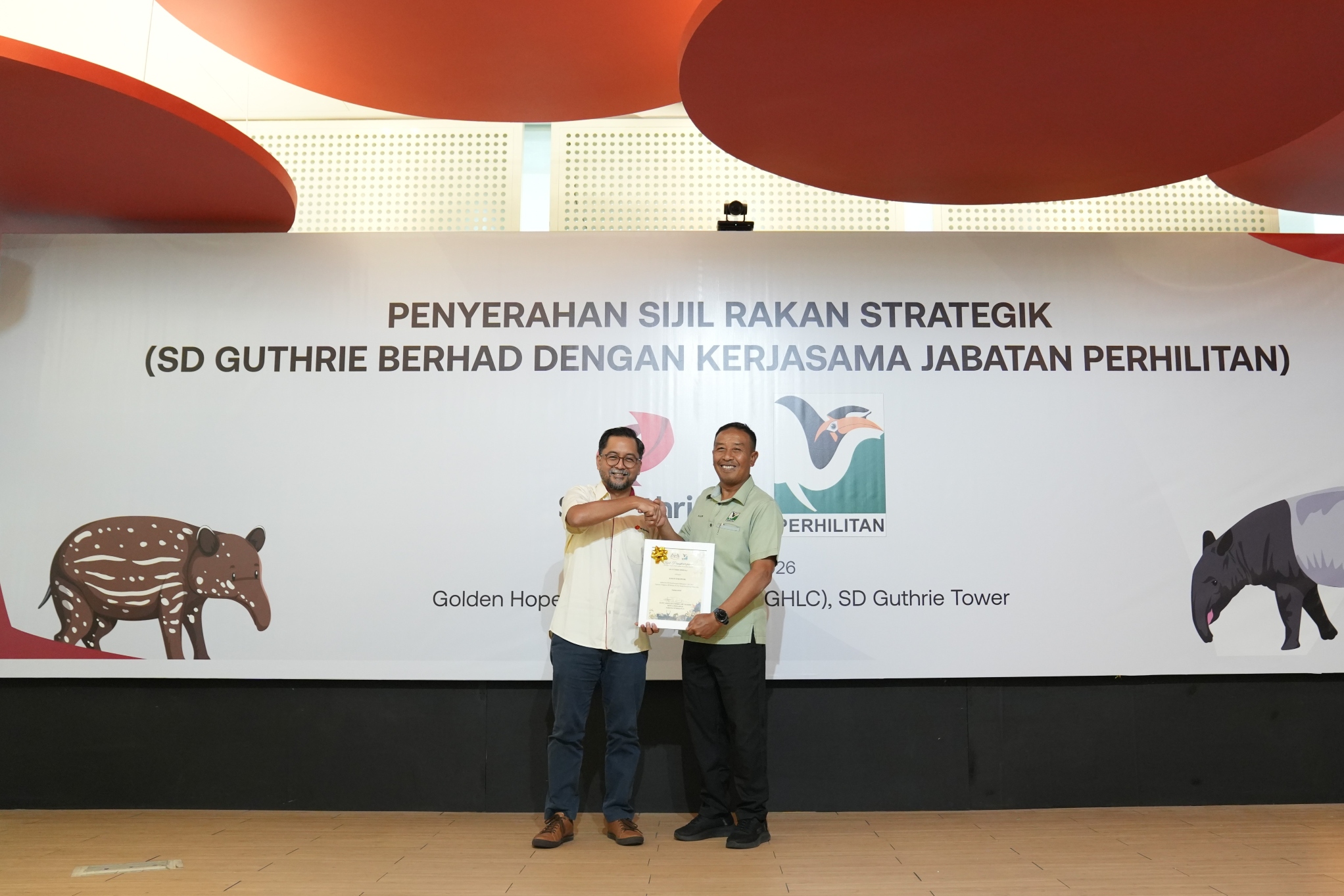
Petaling Jaya, 11 May 2026 – SD Guthrie Berhad (Guthrie) announced its intent to collaborate with the Department of Wildlife and National Parks (PERHILITAN) Peninsular Malaysia as a strategic partner in advancing the conservation of the Malayan Tapir.
The Malayan Tapir or scientifically known as Tapirus indicus is classified an endangered species on The International Union for Conservation of Nature’s (IUCN) Red List, and the Red List of Mammals for Peninsular Malaysia. Its population is declining with fewer than 2,500 mature individuals remaining in the wild as of assessment published in 2016 (IUCN).
The species is a uniquely significant within Malaysia’s natural heritage, and continues to face increasing threats from habitat fragmentation, land-use changes, and other environmental pressures. Addressing these challenges requires a coordinated and inclusive approach involving government agencies, the private sector, and local communities.
Speaking at a recent event to celebrate World Tapir Day, Guthrie's Chief Sustainability Officer, Rashyid Redza Anwarudin, called for a holistic approach by government agencies, the private sector and communities to collaborate on the conservation of wildlife like the Malayan Tapir.
“The Malayan Tapir is a unique and important part of our nation’s biodiversity, yet it faces growing challenges that require a more collective and coordinated response. We are excited to partner with PERHILITAN in this collaboration, which will bring together PERHILITAN’s policy leadership and technical expertise, and Guthrie’s platforms, reach and community engagement capabilities,” he said.
Guthrie’s conservation efforts are anchored in a landscape-level approach that integrates biodiversity protection within its operational footprint. As of 2025, the Group has conserved and restored 51,212 hectares of land across its operations and surrounding landscapes, supporting critical habitats and ecological connectivity for wildlife, including the Malayan Tapir.
These efforts are part of a broader commitment to conserve and restore more than 100,000 hectares by 2030, with a focus on protecting High Conservation Value areas and strengthening ecological corridors across Malaysia, Indonesia, Papua New Guinea, and Solomon Islands.
Complementing habitat protection, Guthrie continues to strengthen its species conservation approach through active restoration and ongoing biodiversity monitoring initiatives across its operating landscapes. In 2025, 19 camera traps were deployed within estates to support ongoing wildlife monitoring and inform conservation management actions. These efforts have recorded the presence of rare, threatened, and endangered (RTE) species such as the Malayan Tapir, and others.
Through its Conservation & Biodiversity Unit, Guthrie aims to support the implementation of the Malayan Tapir Conservation Action Plan (MATCAP), particularly under the Communication, Education, Participation and Awareness (CEPA) component.
Key areas of collaboration include:
• Supporting habitat protection and ecological corridors within operational landscapes
• Organising joint field-based conservation initiatives
• Implementing mitigation measures to reduce risks to tapir populations
• Enhancing awareness among estate management and surrounding communities
The partnership is envisioned as a long-term collaboration, beginning with this strategic alignment and potentially progressing towards a formal Memorandum of Understanding (MoU) in the future.
To download PDFs:
English
